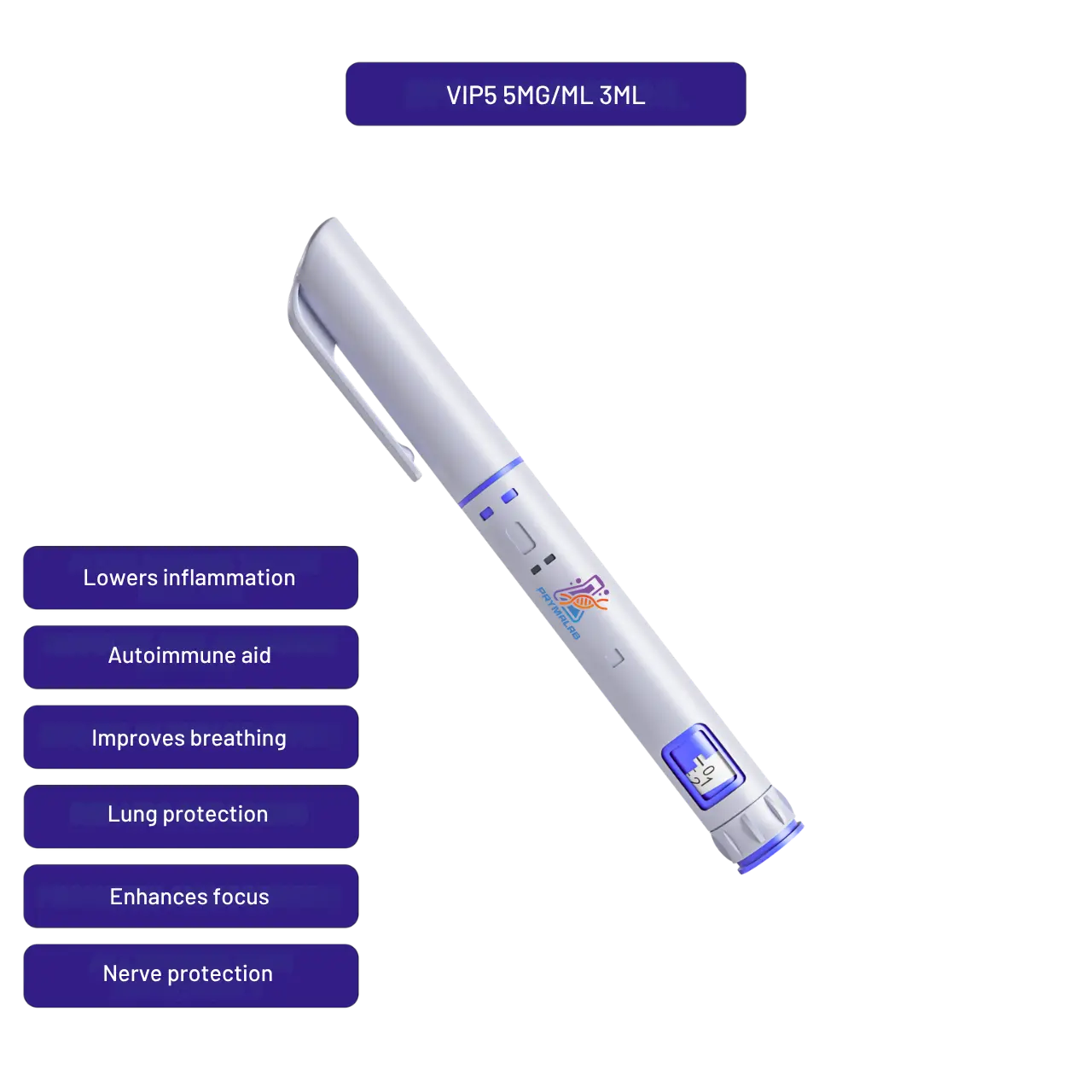
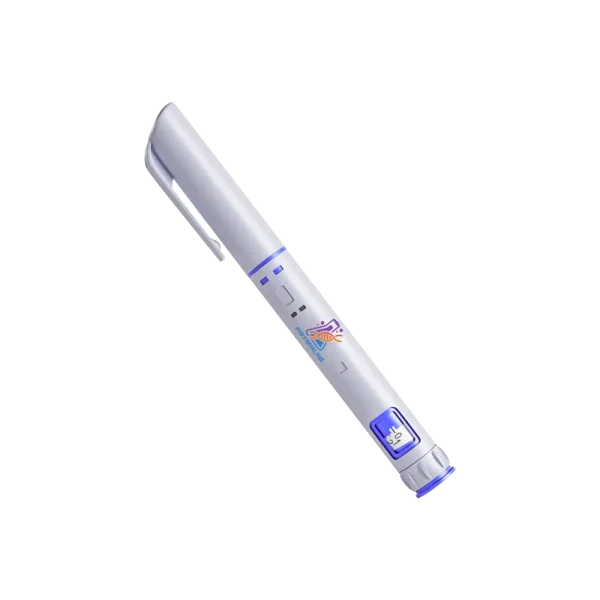
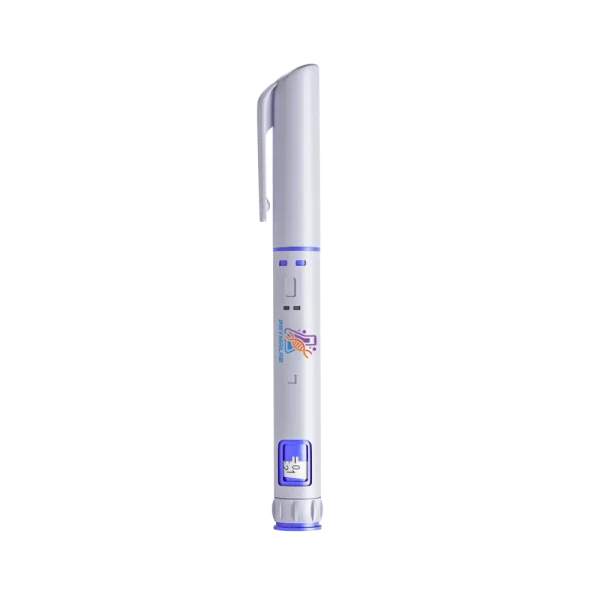
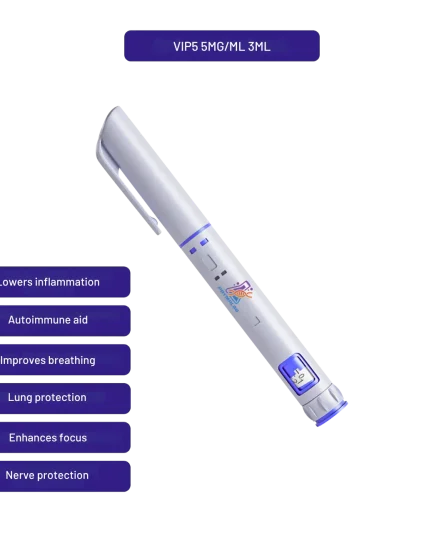
The VIP5 autoinjector is a preloaded 3ml research device containing vasoactive intestinal peptide in solution at 5mg/ml, giving 15mg of total peptide. VIP is a 28-residue peptide with no protease-resistant modifications, which makes solution-state supply a more consequential decision than it would be for a stabilised analogue.
Specification Table
VIP5 autoinjector device and compound data
| Property |
Value |
| Device format |
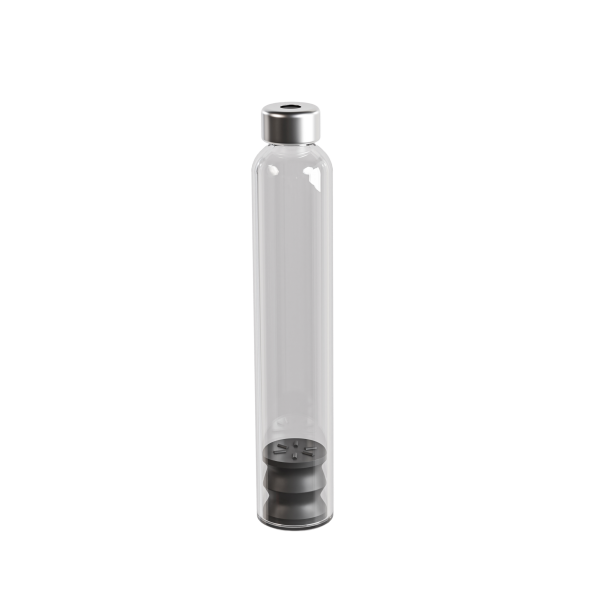
Preloaded autoinjector pen, glass cartridge |
| Fill volume |
3 ml |
| Concentration |
5 mg/ml |
| Total compound in device |
15 mg |
| Molar concentration |
Approximately 1.5 mM |
| Compound |
Vasoactive intestinal peptide (VIP) |
| CAS number |
37221-79-7 |
| Molecular formula |
C147H237N43O43S |
| Molecular weight |
3326.83 g/mol |
| Residue count |
28 |
| Single-letter sequence |
HSDAVFTDNYTRLRKQMAVKKYLNSILN |
| Primary receptors |
VPAC1 and VPAC2 |
| Reconstitution required |
None. Supplied as solution |
| Excipient system |
Not published on the product record. Confirm against certificate of analysis |
| Solution pH |
Not published on the product record |
| Solution stability |
Not established over device shelf life in published data |
| Storage |
2-8°C, protected from light |
| Oxidation-sensitive residue |
Methionine at position 17 |
| Purity |
Per lot-specific certificate of analysis |
| Regulatory status |
No approved human or veterinary formulation in any jurisdiction |
What Does Solution Supply Mean for an Unmodified Peptide?
VIP carries no protective modifications. It is the native 28-residue sequence, which is precisely why it is useful as a research tool and precisely why it is fragile.
A lyophilized cake suppresses the degradation routes that matter. Water is largely absent, so hydrolysis is slow. Molecular mobility is low, so aggregation is limited. Oxygen access to the methionine at position 17 is restricted by the solid matrix.
In solution all three routes reopen. Deamidation at asparagine and glutamine residues proceeds in aqueous conditions and VIP contains several. The methionine is exposed to dissolved oxygen. Aggregation becomes possible in a way it is not in a dry cake.
This is not an argument against the format. It is an argument for knowing the shelf-life stability data, which the product record does not currently state, and for treating time-in-solution as an experimental variable rather than a logistics detail.
What Should Be Requested From the Certificate of Analysis?
Three values, and none appears on the product record available here.
Solution pH is the first. VIP solubility and stability are pH-dependent, and deamidation rates in particular vary sharply with pH. A formulation at pH 4 behaves very differently over six months from one at pH 7.4.
The excipient system is the second. Whatever buffer, tonicity agent or preservative is present enters every assay the solution is added to. Some preservatives are not inert in cell culture, and a benzyl-alcohol-preserved formulation is not suitable for every downstream readout.
Shelf-life stability data is the third and most valuable. For a peptide with this degradation profile, a manufacturer stability study is the difference between knowing what is in the device at month six and guessing.
These are reasonable things to ask for and unreasonable things to assume. Request them before quantitative work rather than after an unexplained potency drift.
How Should Delivered Volume Be Verified?
Search demand reaching this page is device-oriented, so the mechanics deserve as much space as the pharmacology.
Gravimetric verification is the practical method. Actuate the device onto a tared weighing vessel, record the delivered mass, and convert using solution density. Repeat across several actuations to capture accuracy against nominal volume and precision between draws. The whole exercise takes minutes and it is the only way to know what the device actually delivers rather than what it claims.
Run the verification at the temperature the device will be used at. Cold solutions are more viscous and viscosity affects delivery in a spring-driven mechanism, so a check performed straight from refrigeration describes a condition that will not apply in use.
Discard the first actuation after any rest period rather than measuring it. Pen mechanisms frequently under-deliver on the first actuation because air enters the delivery path or seals relax. Follow any specified priming step and record it. Where none is specified, let the gravimetric data establish the behaviour before trusting the draw.
What Does the VIP5 Autoinjector Format Suit?
The strongest case is consistency across many equivalent draws. Every actuation comes from one solution prepared once under controlled conditions, which removes preparation variability entirely as a between-experiment factor.
That matters more for VIP than for a well-supported small molecule, because manual reconstitution of a fragile peptide introduces several invisible failure modes: shear from over-agitation, incomplete dissolution, adsorptive loss during transfer, and variable time-to-use after reconstitution. A device eliminates all of them at the cost of fixing concentration at manufacture.
The format suits less well any design needing a concentration series prepared from stock, or work extending over many months where the accumulated time in solution becomes a concern.
At 5 mg/ml the solution is approximately 1.5 millimolar. Reaching the low nanomolar working range typical of VPAC pharmacology needs roughly a 1.5-million-fold dilution, the same arithmetic as a 5mg vial reconstituted into 1 ml.
What Happens to a Peptide Solution Over Time?
Three degradation routes matter for the VIP5 autoinjector and any unmodified peptide held in solution, and each produces a different analytical signature.
Deamidation converts asparagine and glutamine side chains to aspartate and glutamate, adding one dalton per event and introducing a negative charge. VIP contains several susceptible residues. The rate depends strongly on pH and on the residue immediately following the susceptible one, and asparagine followed by glycine is the fastest-deamidating pair known.
Oxidation targets the methionine at position 17, adding 16 daltons. Dissolved oxygen is sufficient over time, and trace metal contamination accelerates it considerably.
Aggregation produces no mass change at all in the monomer, which is what makes it the hardest of the three to detect. Size-exclusion chromatography resolves it. Mass spectrometry of the monomer peak will look entirely normal while a substantial fraction of the material sits in aggregates the method never samples.
The practical point is that a single analytical method will miss at least one of these routes. Mass spectrometry catches deamidation and oxidation and misses aggregation. Size exclusion catches aggregation and misses the other two. Where solution shelf life genuinely matters, both are needed.
Why Device Format Suits Some Questions and Not Others
Choosing a preloaded device over a vial is a methodological decision with consequences beyond convenience, and it is worth making deliberately.
The device wins where between-session consistency is the priority. Every draw comes from one solution prepared once, so preparation variance disappears from the experimental design entirely. For a study running many equivalent replicates over weeks, that is a genuine improvement in data quality rather than a convenience.
The vial wins where flexibility matters. A concentration series prepared fresh, an unusual diluent, a carrier protein added at reconstitution, or simply a different stock concentration than the manufacturer chose are all straightforward from a lyophilized cake and awkward or impossible from a fixed solution.
The vial also wins on shelf life. Dry material at minus 20 degrees is stable for far longer than any peptide solution, so a study that will run intermittently across a year is better served by lyophilized stock and fresh reconstitution than by a device slowly degrading in a refrigerator.
Neither format is better in the abstract. The question is which variable the study most needs to control.
Handling the Device in Laboratory Practice
Store the VIP5 autoinjector at 2-8°C protected from light and return it to its packaging between sessions. The methionine at position 17 is photosensitive as well as oxygen-sensitive, so cumulative light exposure is worth limiting rather than ignoring.
Let the device equilibrate to ambient temperature before actuating, then inspect the solution. It should be clear and free of particulate or visible haze. Aggregation in peptide solutions often presents as faint opalescence before it becomes obvious turbidity, so inspect against a dark background as well as a light one.
Record device lot, date of first actuation, storage conditions and volume drawn each session. For a device used across weeks the interval between first use and each subsequent draw is an experimental variable, and for a peptide with this stability profile that interval belongs in the data record rather than in memory.
Published Literature
Verified against publisher records or primary indexes. All concern the peptide itself, since no published data exists for this delivery format.
- Said SI, Mutt V. Science. 1970;169(3951):1217-1218.
- Harmar AJ, Fahrenkrug J, Gozes I, Laburthe M, May V, Pisegna JR, Vaudry D, Vaudry H, Waschek JA, Said SI. British Journal of Pharmacology. 2012;166(1):4-17.
- Couvineau A, Laburthe M. British Journal of Pharmacology. 2012;166(1):42-50.
- Delgado M, Ganea D. Amino Acids. 2013;45(1):25-39.
- Dickson L, Finlayson K. Pharmacology and Therapeutics. 2009;121(3):294-316.
Frequently Asked Questions
What is the VIP5 autoinjector?
A preloaded 3ml research device containing vasoactive intestinal peptide in solution at 5mg/ml, which gives 15mg in total and roughly 1.5 millimolar in the cartridge. Nothing needs reconstituting before use. For laboratory research only, with no approved human or veterinary formulation in existence.
Why does solution supply matter more for VIP?
Because VIP carries no protease-resistant modifications. It is the native 28-residue sequence. A lyophilized cake suppresses hydrolysis, aggregation and oxidation at the position 17 methionine. In solution all three routes reopen, and deamidation at asparagine and glutamine residues proceeds as well.
What should be requested from the certificate of analysis?
Solution pH, the excipient system, and shelf-life stability data. None appears on the product record. Deamidation rates vary sharply with pH, excipients enter every downstream assay, and for a peptide with this degradation profile stability data is the difference between knowing and guessing.
How should delivered volume be checked?
Gravimetrically. Actuate onto a tared vessel, record the mass, convert using solution density, and repeat across several actuations to capture both accuracy and precision. Run the check at the temperature the device will actually be used at, not straight from refrigeration.
Why is the first actuation unreliable?
Pen mechanisms often under-deliver on the first actuation after a rest period, because air enters the delivery path or seals relax. Follow any specified priming step and record that it was done. Where none is specified, establish the behaviour gravimetrically before trusting the first draw.
What concentration does the device hold?
Five milligrams per millilitre, approximately 1.5 millimolar. Reaching the low nanomolar range typical of VPAC receptor pharmacology requires roughly a 1.5-million-fold dilution, which is the same arithmetic as a 5mg vial reconstituted into 1 ml. The device offers no dilution advantage.
When is a pen better than a vial for this compound?
When many equivalent draws are needed and manual reconstitution would otherwise introduce shear, incomplete dissolution, adsorptive loss and variable time-to-use. A device removes all four. It suits less well any design needing a concentration series or work extending over many months.
What should be inspected before use?
Examine the solution against a dark background as well as a light one. It should be clear with no particulate. Aggregation in peptide solutions frequently presents as faint opalescence before it becomes obvious turbidity, and a dark background makes that early stage far easier to see.
Does light exposure matter for VIP?
It is worth limiting. The methionine at position 17 is sensitive to both oxidation and light-driven degradation. Returning the device to its packaging between sessions costs nothing and reduces cumulative exposure across the weeks a device may remain in use.
What should be recorded for each session?
Device lot, date of first actuation, storage conditions, and volume drawn. For a device used across weeks, the interval between first use and each subsequent draw is an experimental variable. Given this compound stability profile, that interval belongs in the data record.
What degradation routes matter for a peptide in solution?
Three. Deamidation converts asparagine and glutamine to aspartate and glutamate, adding one dalton and a negative charge. Oxidation targets the position 17 methionine, adding 16 daltons. Aggregation produces no mass change in the monomer at all, which makes it the hardest to detect.
Why is aggregation hardest to catch?
Because it changes nothing about the monomer. Mass spectrometry of the monomer peak looks entirely normal while a substantial fraction of material sits in aggregates the method never samples. Size-exclusion chromatography is the technique that resolves it, and it is frequently skipped.
Can one analytical method cover solution stability?
No. Mass spectrometry catches deamidation and oxidation but misses aggregation. Size exclusion catches aggregation and misses the other two. Where solution shelf life genuinely matters to the work, both are needed, and running only one gives false reassurance.
Compliance Statement
The VIP5 autoinjector is sold exclusively for laboratory research use. It is not a drug, food, or cosmetic product, and it is not a dietary product of any kind. It is not approved by the FDA or any comparable authority for human or veterinary use. This product is not intended to diagnose, treat, cure, or prevent any disease. It must not be given to humans or animals. Purchase is restricted to qualified researchers and institutions operating within applicable laws. All handling is the responsibility of the purchasing laboratory.












19 reviews for Preloaded Autoinjector | VIP5 (Vasoactive Intestinal Peptide) | 3ml Pen | 5mg/ml